
By James Booth
If I just bought it, it's new to me. Like everything else these days, photography equipment, whether digital or film, can run into rather high dollar amounts. How is the budget-minded photographer supposed to keep up with inflation? With quality, used equipment, that's how. If you just bought it, it's new to you, isn't it?
I must confess, other than my wife's Minolta Maxxum 300si, I've never bought a brand new camera in my life. I think everything costs too much. So to defray the cost of my photo equipment, I'm content to buy a used version of last year's model, or even the year before.
As a matter of fact, other than my tripods, reflector umbrellas, slaves and cords, all of my other photo equipment is used. By purchasing used equipment, you can often get a higher quality item than if you were to buy the newest, latest and greatest thing to hit the market. A prime example is the camera I bought a year ago.
Around this time last year, I decided that it was time to buy a new camera. At the time, I had a Mamiya M645, a medium format film camera. For more information on medium format photography, see our article "What's medium format?" in the May 2004 issue of Connected Photographer Magazine, http://www.connectedphotographer.com/issues/issue200405/00001280001.html.
The M645 was the first model of 6x4.5 medium format film camera that Mamiya made, and debuted in the mid-70s. This particular camera was purchased new by my grandfather, and passed on to me when my daughter was born.
By now though, the silver coating on the prism inside the prism finder was beginning to come off. This had no effect whatsoever on image quality, as the finder is only used for viewing, not for exposure. But it did make it kind of difficult to focus sometimes because the band where the silver was coming off ran directly across the middle of the focusing area.
Repair or replace?
In dealing with this problem, I had several options, as the prism couldn't be repaired or replaced. I could replace the entire prism finder with a used one, as new ones for that particular model are no longer available. I could switch to a waist-level finder. I could deal with it. Or, I could just replace the whole camera, which is what I chose to do since that camera was just shy of 30 years old.
I now had a few rather difficult decisions to make. What model of camera to get? Film or digital? New or used? After a bit of research into quality, available models, and price, I decided to stick with film, which meant medium format. Once I left 35mm for medium format, there was no going back.
For what I paid for the camera I chose, I could have bought a brand new digital Rebel like the one shown in Figure A.
FIGURE A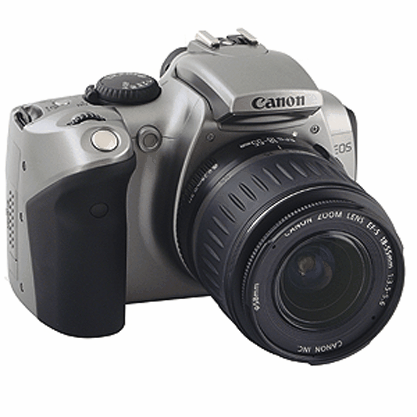
The Canon EOS Digital Rebel, one of the first digital single lens reflex cameras. (click for larger image)
But frankly, I'm just not that confident I'll get the same quality I do with film. When you consider the image sensor on the digital Rebel is the same size as a 35mm frame, or if I recall, just slightly smaller, it would actually be like a step backwards. Digital medium format cameras are available, but run in the same neighborhood as a good used car, which was out of my range.
In the end, I chose a used Mamiya 645 Pro, one model back from the current retail 645 Pro TL. For comparison, the brand new Mamiya 645 Pro TL, with all of the accessories I purchased, retails for $3000. I paid $1200 for my used, in-new-condition, 645 Pro shown in Figure B.
FIGURE B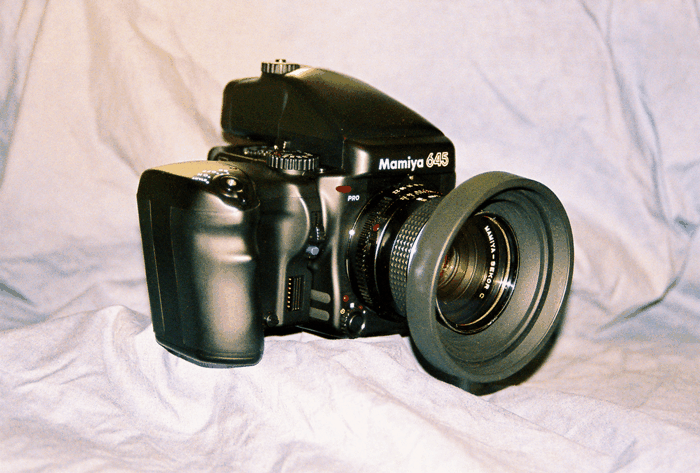
For the same price as a lesser new model, you get a lot more used. (click for larger image)
The only real difference between the Pro and the Pro TL is, the Pro TL is TTL (Through The Lens) enabled for metering through the lens with TTL capable flash units. Since none of the flash units I use are TTL enabled, I didn't see the point in spending the extra money for the Pro TL.
Where to look
So let's get on to the point, where to find all this great used equipment. There's a wealth of resources available for quality used photo equipment. One of the first places to check would be your local photography store, and I don't mean someplace like Ritz. I mean a store that caters to the professional photographer. These stores often have used equipment for sale that has been traded in when a photographer upgrades, or sometimes they have equipment that's for sale on consignment.
There is, of course, your local classified ads, or the classified ads in many of the photo trade magazines. There's eBay of course, where great deals on many things can be found. I myself have sold several of my old cameras on eBay when I've upgraded. But there are actually retailers that specialize in used equipment; this is where the real gold is.
One of the retailers I've done a great deal of business with is KEH. They run a print catalog, but also maintain a Web presence. Over the years I've bought a flash meter, flash, various manuals, covers, and my last camera from KEH. They specialize primarily in used equipment, but also carry new. Whether you're looking for digital, film, studio equipment, or darkroom equipment, you can pretty much find it at KEH.
KEH uses a grading system ranging from New to Ugly, so you'll have an idea of the quality of the item you're getting. I've never bought anything that was rated below Excellent, but I can honestly say that every product I've bought from KEH was like brand new.
There's one little glitch with KEH. None of the products come with manuals; you have to buy them separately. And they won't always have a manual for the product you want. I would expect to find a manual with any brand new product you bought from them, but unless otherwise stated, use products don't come with manuals.
Two other retailers that sell used equipment, both with an online presence, are B&H Photo, and Adorama. I've never actually dealt with Adorama, but I've bought both new and used equipment from B&H Photo. The down side to both of these retailers is that they deal primarily in new equipment. They do offer some used equipment, but nowhere near the level of merchandise of KEH. Like KEH, they use a grading system to convey the quality of their used products.
So here ends our lesson. By shopping around your neighborhood and on the Internet, you can find a great deal on an almost new camera. The money you'll save buying used can be spent on a better model, or invested in other equipment, like a flash meter or light unit. Good luck and good shooting.