
By David Gewirtz
Buried deep within the brittle, crumbling pages of the Codex Sinaiticus may well be hidden answers to questions that have haunted historians and religious scholars for centuries. Digital imaging may be the tool that helps researchers find a real-life Bible Code.
Our story begins between 3,295 and 3,449 years ago, during the reign of either Amenhotep II or Ramses II. As always, scholars disagree.
Mount Sinai
Imagine you, your family, and nearly everyone you know have been slaves. Suddenly, you're driven from your home and have to survive in the desert. You've spent three months in the desert. Your days are sweltering but at night, the temperature drops to close to freezing. Your journey is the stuff of legend.
Finally, your leaders stop and set camp below a huge mountain sometimes called Mount Horeb. You're there for nearly a year before your journey continues. Thousands of years later, the story of your time below Mount Horeb will be recounted in the last twenty-two chapters of Exodus, together with the whole of Leviticus, and the first eleven chapters of Numbers.
"An epic debate, a battle of words that's quite literally biblical in proportion..."
Mount Horeb, of course, is also known as Mount Sinai. Thousands of years would go by and the real location of Mount Sinai would fade. But about 1,700 years ago, two monks claimed they found the location of the legendary Burning Bush, located in Jabal Musa, in present day Egypt.
Back then, those monks would have traveled by camel at about three miles an hour, doing nearly twenty five miles in a day. Even at best speed, it would have taken the better part of a month to reach the base of the Mount from Cairo. Today, of course, you can travel to Mount Sinai by car. The trip is about two hours from Dahab, a popular and happenin' resort town at the southern tip of the Sinai Penninsula.
The mountain in the Sinai Penninsula we call Mount Sinai is unlikely to have been the one visited by biblical legend. There's a considerable body of academic evidence pointing away from Egypt and, instead, to Jabal al-Lawz in Saudi Arabia or even the volcano Hala-'l Badr, further south in Arabia.
Not knowing about these current academic theories, our two intrepid monks of the year 300 c.e. were successful in making their case for the Jabal Musa location in Egypt. In 527, by order of the Emperor St. Justinian the Great, a monastery was built at the base of the site we now call Mount Sinai.
St. Catherine's Monastery
It's here, at the Monastery of St. Catherine, one of the oldest and longest running monasteries in the world, that our mystery continues. St. Catherine's Monastery, shown in Figure A, claims to guard the site of the Burning Bush, survived an invasion from Islam and still has in its posession a letter of protection from Islam's founder, Mohammed, himself. Named for St. Catherine of Alexandria, monks at the monastery claimed in the 9th-century that relics of St. Catherine were mysteriously transported there.
FIGURE A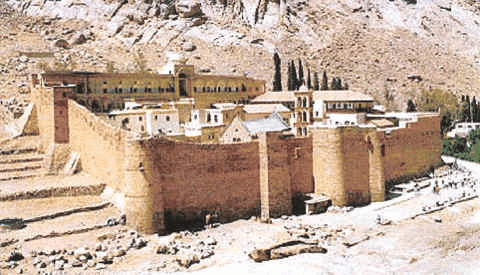
St. Catherine's looks more like a fortress than a monastery. (click for larger image)
Sacred relics aren't the only ancient artifacts located at the Monastery of St. Catherine. The monastery's library collection, which is second only the manuscript library of the Vatican, contains more than 3,500 volumes in Greek, Coptic, Arabic, Armenian, Hebrew, Slavic, Syriac, Georgian and many other languages.
This, of course, brings us back to the Codex Sinaiticus and its checkered past.
The mysterious story of the Codex Sinaiticus
To most of us living in the modern age, the Bible is the Bible. Regardless of what religious background you hail from, the Bible is considered by most to be a fixed document, a collection of stories, guiding principles, laws, and values that, together, comprise the foundation for many modern-day religions.
But the Bible is anything but fixed. In fact, it has mutated over and over for thousands of years. And therein lies the foundation for an epic debate, a battle of words that's quite literally biblical in proportion.
To many devout believers throughout the world, what the Bible says defines their lives. Every aspect of their belief system is based on the fundamental truths they take from this single book. If it were possible to change what the book says, it would have a profound effect on all aspects of their lives, their beliefs, and their relationship with their religon.
Change what the book says and you rock their world.
The problem is, it's hard to really, really know what the Bible says. It's a document that has gone through many, many transformations, interpretations, and translations. Entire books, called the apocryphal works, contain biblical stories that at one time were considered part of the Bible itself. The Bible has been translated into more than 2,100 languanges and has been translated more times and into more languages than any other book.
"What are people supposed to believe when the actual Bibles themselves don't agree?"
One way that religious scholars and historians can determine with some accuracy the original intent in the Bible is to read original versions of the Bible. If you could, for example, read the Bible as it was written three hundred years or so after Christ was supposed to have lived, you're likely to get a much more accurate picture of the intent of the religion than you would reading the King James Version or the New American Bible.
This might help you understand why Constantine Tischendorf was so excited back in 1844. Tischendorf was a biblical scholar and was traveling throughout the ancient lands in search of manuscripts. This was before we had air-conditioned planes, trains, or automobiles, so you gotta pretty much assume the guy was dedicated in the extreme.
In time, his travels took him to the Monastery of St. Catherine. Apparently, the "circular file" existed back then as well. While working in the library, Tischendorf noticed a basket containing loose manuscript pages. Among those pages were several "leaves" of the oldest Greek writing he'd ever seen -- and which contained parts of the Greek Bible.
He recovered 43 leaves and, in a discussion with the monastery's librarian at the time, learned that two basket loads of similar waste paper had already been burned in the monastary's furnace. What Tischendorf had found were portions of an Old Testament Bible, dating back to sometime around the year 340.
As you might imagine, this was the biblical scholar's equivalent of catching Mark McGwire's record-setting home run ball, when McGwire broke Roger Maris' 61 home runs in a single season record, a record that stood for almost 40 years. Sadly, McGwire later admitted to mainlining the androgenic steroid Androstenedione during that record-breaking year. But that's another story.
Like a record-setting baseball, the leaves belonging to this most-ancient of Bibles were eminently collectable. Tischendorf started the collection process by whisking away his 43 leaves, bringing them back to Europe. Tischendorf must not have had much of a poker face, because when he later found another 80 or so leaves, the monks in the monastery declined to let him have them, or even see them.
Adventurous Tischendorf returned to the monastery in both 1853 and 1859, but no Biblical joy was to be had. The monks were now wise to his game. Strangely, though, just as he was about to leave the monastery empty-handed, he got into a discussion with the steward of monastery. Tischendorf showed this steward a newly published copy of his Septuagint, a Greek translation of the old Testament.
"The monastery at the base of Mount Sinai is getting some shiny new toys."
In a wacky, biblical game of "I'll show you mine if you show me yours," the steward whipped out his own copy of the Septuagint. The monastery's steward had produced a heap of loose leaves, wrapped in cloth, that turned out to be not only the remaining pages of the Old Testament, but an entire New Testament as well, all dating back to the year 340 or so.
At first, Tischendorf tried to talk the monk out of his collection. Then, he attempted to buy it. When neither of these approaches worked, he left, determined to negotiate a deal for the document.
If you thought this tale had it all: Mount Sinai, the Burning Bush, hidden Bibles, and both Roger Maris and Mark McGwire, it gets better. Now, we're going to mix in a Csar of Russia and, soon, Stalin's U.S.S.R. This is a heck of a story. And yes, we'll be talking about photography soon. I promise.
Our friend Tischendorf was quite determined to get his hands on that manuscript. Back in Cairo, Tischendorf managed to locate the Superior of the monastery (basically, the monk the monks reported to). Silver-tongued devil that he was, Tischendorf managed to talk the Superior into letting him have access to the leaves in Cairo.
Every few weeks, Tischendorf was given a few more leaves to copy and then return. Clearly, this wasn't what Tischendorf wanted and since going to the boss worked once, he decided to go for broke.
Back in the U.S.S.R.
It all begins to come together when you understand that the monks were part of the Greek Church, and, at that time, the "protector" of the Greek Church was the Csar of Russia. It seems the unassuming monks of St. Catherines wanted to some say over who became the next Archbishop. Since the Csar had considerable influence in the election of said Archbishop, a deal was struck. The Csar (and Tischendorf) got the leaves and the monks got their influence. The monks also managed to score some 9,000 rubles and some "decorations" as well -- as part of a counter-gift dictated by the "customs" of the time.
And that's how, in 1859, the Codex Sinaiticus, shown in Figure B, wound up traveling from Mount Sinai, in Egypt to Saint Petersburg, in Russia.
FIGURE B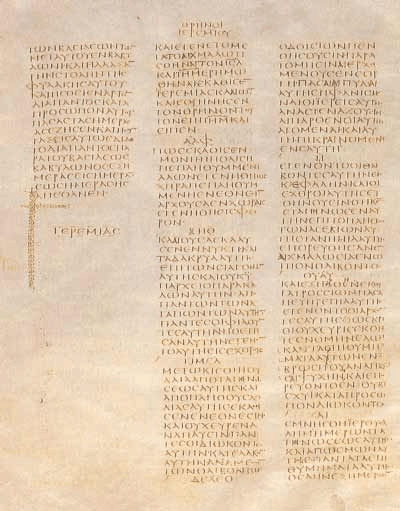
One of the oldest Bibles in existence, this document sure does get around. (click for larger image)
We're not yet done with the 19th-century, or Constantine Tishendorf. Our intrepid biblical scholar seemed to get his nose into everything. In the late 1850s, his nose got a whiff of another Constantine, one Greek named Constantine Simonides. Seems this Constantine had a little larceny in his soul and had been creating a considerable sensation by manufacturing Greek manuscripts claiming to be of astounding antiquity. When these documents were exposed as forgeries, one of the scholars turning the screws on Simonides was no less than our very own Tishendorf.
In a twisted attempt to get back at Tischendorf, Simonides determinedly maintained that all his documents were original, except for one. That one he claimed he'd forged. Can you guess which document Simonides claimed he'd forged? Of course you can: the Codex Sinaiticus. The joke really ticked off Tishendorf, but was later disproved. The Codex Sinaiticus has been declared genuine.
At this point, the Constantines Simonides and Tishendorf fade into history and our story moves to the U.S.S.R. of 1933.
While earlier Russian leaders aligned themselves with the church, the Soviet leadership under Ioseb Jughashvili (who we know as Stalin) had little use for religious artifacts and considerable use for cash. Although the Soviet government conducted some negotiations with an American cartel for the sale of the Codex Sinaiticus, the British Museum managed to land this priceless manuscript for a mere 100,000 pounds.
42 years later, in May 1975 during restoration work, the monks at St. Catherine's monastery discovered a room under the St. George chapel which contained parchment fragments. Among these fragments, 13 missing Old Testament pages from the Codex Sinaiticus were found.
And this brings our story up to present day.
Portions of the Codex Sinaiticus are now, in 2005, located in the British Library in London, St. Catherine's Monastery, the Leipzig University Library, and the National Library of Russia in St Petersburg.
So here we have one of the earliest copies of the Bible, and it contains both the Old and New Testaments. Intrigue, thievery, and church politicing aside, this document gives biblical scholars a unique chance to see what was really written in the Bible, way back when the Bible was being written.
Or...does it?
What's got the collective knickers of biblical scholars in a collective bunch is that what's written in the book is not necessarily what was originally written in the book.
Enter the Wikipedia
This'll make a lot more sense if we first discuss another document that changes over time and also has scholars' up in arms: the Wikipedia.
The Wikipedia (at http://www.wikipedia.org) is a collectively-written encyclopedia available online. At this moment, there are more than 600,000 articles in the Wikipedia, many of which are extremely professional in their presentation and discussion.
What makes Wikipedia fascinating is that anyone can go in and modify any article. Do you want to edit the Codex Sinaiticus article to say it was written by Bugs Bunny on crack? Go ahead. Do you want to change the entry on Dick Cheney to say he never swears and broke Mark McGwire's home run record? Go ahead. We'll wait.
From this, you might think the Wikipedia can't work. But it's got a powerful set of checks and balances that makes it work amazingly well. If you make changes like those I just described, Wikipedia records the version of the article before and after the change. Someone else will just come along and undo the change. Unless you're obsessively dedicated to checking your entries ten times a day, your changes will eventually be removed and accurate entries will take their place.
"They're starting with a camera that can take photos up to a resolution of 72 megapixels."
Certain scholars, particularly those who make their living publishing commercial encyclopedias, hate Wikipedia with a passion. Regular people, without supervision, and able to edit anything without restriction, can not possibly keep a document accurate, they claim. The fact is, Wikipedia works. It manages the flow of changes by allowing changes to be made, and to be reverted, to be discussed, and to be tracked. It is an astounding work of collective scholarship and this article wouldn't have been possible without the Wikipedia and other Internet research resources.
In fact, if you really want to see how the flow of changes in Wikipedia works (and this is well worth the 8 minutes and 29 seconds you'll be giving up), I strongly recommend you watch Jon Udell's screencast at <A target="_blank" HREF="http://weblog.infoworld.com/udell/gems/umlaut.html">http:\//weblog.infoworld.com/udell/gems/umlaut.html</A>. Make sure your sound is on.
John's narration shows how the article entry about the Heavy Metal Umlaut, a symbol often used above certain band names, changes over time -- getting more and more accurate as well as more and more universally, politically acceptable.
What was really written?
Now assume that you're no longer in the year 2005, but, oh, say in the year 505. You're reading the original Codex Sinaiticus and you don't like how something was written. You can't just edit it like you can in Wikipedia, but you can make certain changes, erase things from pages, and add in new stuff.
For example, two verses in the Codex Sinaiticus discuss the lovely concept known as "Bloody Sweat" and an angel who appeared to strengthen Christ "in his agony". Strangely, though, the two other surviving Bibles from the time, the Codex Alexandrinus and Codex Vaticanus, do not contain these mentions in the same verses. Which is it? Was there bloody sweat or was there no bloody sweat? Was there an angel or was there not an angel?
What are people supposed to believe when the actual Bibles themselves don't agree?
If this were the Wikipedia, you'd be able to go back and see if the Codex Sinaiticus always had mentions of angels and bloody sweat, and if those entries were added later, you'd be able to see when, and by whom. In the case of the Codex Sinaiticus, there's no such luck.
Until now, it was virtually impossible to perform this sort of textual analysis, the attempt to dig down through a manuscript's history and see how it's been changed, mutated, edited, annotated, and otherwise fiddled with. In that elusive search for the original words, scholars haven't been able to figure out what's real and what's the result of creative retouching.
Until now.
Hyperspectral imaging
And, now, finally, this brings us to the subject of photography. I told you I wouldn't let you down! You see, the Monastery of St. Catherine at the base of Mount Sinai is getting some shiny new toys.
They're starting with a camera that can take photos up to a resolution of 72 megapixels. Back in the late 19th-century, biblical researchers decided to try to see what the pages of the Codex Sinaiticus were hiding. So, like good researchers, they dunked the thing in toxic chemicals. For a few moments, some underlying text was made visible, but the result was the parchment became far more brittle. Good going, guys!
Today, it's impossible to get an exact view of the parchment. So researchers are using up to four of these massive digital cameras. "We're taking images from different angles and then knitting the image together, electronically pulling it flat because we may not be able to pull it flat physically," according to Nicholas Pickwoad, a rare book historian who's an advisor to the project.
The technique, called hyperspectral imaging, will use a camera to photograph the parchments at different wavelengths of light, helping researchers see the hidden text and how the document changed over time.
Hyperspectral imaging has been used to map the earth. As Figure C shows, the technique has been used to map water vapor, minerals, chlorophyll concentrations, and more. Now, however, the same basic techniques are going to be applied to biblical science.
FIGURE C
Hyperspectral imaging is used commonly in land management and analysis. (click for larger image)
The technology should allow scholars to read the faint remnants of a washed-out 5th-century text which lie underneath visible 8th-century writing. The underlying text in Syriac is a copy of a 2nd-century translation of the New Testament gospels.
This is the very same technology that the military is using to "see" though camouflage and screening materials. It's a technology that allows soldiers to distinguish between the spectral emissions from man-made and natural materials, significantly improving the detection and identification of hidden intruders and equipment. It's also a technology that's being used to fight terrorism, and to detect hidden objects and people during port inspections and hostage situations.
Apparently, the monks at the Monastery of St. Catherine are still a little pissed at the Russians and Constantine Tishendorf. The Greek Orthodox monks keep (and show at every opportunity) a framed copy of a note left by Tishendorf promising to return the manuscript. Conveniently left out of the church's revised history is how the monks of the 1850s sold the manuscript off to the Russians in return for some influence in church politics and 9,000 rubles (about 18 bucks in today's money).
The monastery has agreed to participate in the project (and, incidentally, get a very slick conservation workshop and a brand new library) on the condition the project includes updating the history of the Codex Sinaiticus. Time has not dulled the wheeler-dealer skills of these remote monks in the slightest.
Perhaps now, after more than 1,700 years, we'll have a chance to know what the Bible really says. Then, perhaps, we can find out who shot J.R., whether there really was a single bullet that killed JFK, and whether Elvis is truly dead.