
By David Gewirtz
The eBay Survival Guide: How to Make Money and Avoid Losing Your Shirt, shown in Figure A, is a new book from No Starch Press by Michael A. Banks. This Q&A session is a first for Connected Photographer. In it, we don't mention photography at all. Michael's book isn't really about photography. But it is about protecting yourself and getting the most out of eBay. And eBay is certainly a hot topic among Connected Photographer readers.
FIGURE A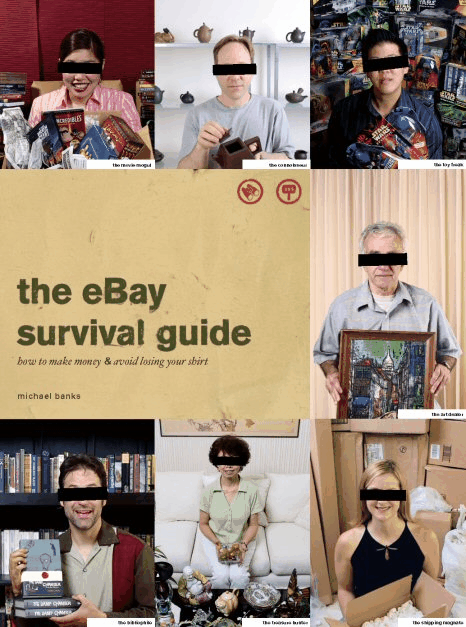
Learn all about eBay safety with The eBay Survival Guide. (click for larger image)
In this interview, Michael shares ways in which you can safeguard yourself while using eBay. While it's not photography, this discussion is so important, we thought you should have the chance to read it. We'll get back to photos, formats, Photoshop, and megapixels next week.
"Any email that asks for a credit card number, checking account number, user ID, and/or password is phishing. Period. Any email that asks you to click on a link and log in to your eBay or PayPal or bank account is a scam."
David:
Tell us about yourself and how you got involved with eBay.
Michael:I began trading online back in the early 1980s, when I sold a printer in a CompuServe Forum for parts. I did a lot of buying and selling of hobby stuff on CompuServe and elsewhere over the next decade, and even conducted an email auction around 1988 (for a collection of autographed science fiction novels).
I watched eBay for quite a while before getting involved. The first year, I found few items of interest, and those were overpriced. Also, I was also a bit skeptical about trust, since in the early days it was pretty easy to get friends to pump up your Feedback if you were a seller. My skepticism was reinforced one day in 1999 when I was in a used furniture store and heard the proprietor -- a part-time minister -- telling an acquaintance how he'd inflated his positive Feedback score. "Get that Feedback up," he said, "and you can get away with anything." Okay, Rev!
But my skepticism was overcome by several successful purchases, and before long I was selling, too.
David:Everyone I know who uses eBay has at least one "got ripped off" story. Is eBay really safe enough to use?
Michael:I've been ripped off twice. One of the first auctions I won was for a book that I really wanted. The seller disappeared after I sent him the money (ten bucks). His email bounced and he stopped selling on eBay. The second ripoff was an item that wasn't what it was described to be.
I've also had buyers try to pull scams on me. One guy wanted to "bargain" with me, saying that he don't really want to pay what he bid, and asking me to take twenty bucks less so he could leave Positive Feedback in "good faith." I said "No," and he paid the full amount. Other people have asked me to send an item they've won so they can make sure they want it. I tell 'em what most sellers would: Send me the money. Then I'll send the item to you, and if you don't like it you can have your money back after you return it, minus shipping both ways.
In every case, the buyer paid, I sent the item, and that was the end of it. I have no way of knowing whether any of those buyers intended to keep their item and not pay, but I avoided the issue by insisting the buyers pay first.
David:How can an eBay buyer protect himself or herself from getting ripped off?
Michael:First, make certain the item is what you think it is. Unfortunately, there are sellers who use deceptive language, misdirection, tiny print, doctored photos, and other tricks in their descriptions to mislead buyers into thinking a used item is new, that a reproduction or reprint is an original, and so on. If you have any doubts about the item, write the seller and ask -- and don't bid until your questions are answered. If it will help, ask for additional photos of the item in question.
"The best protection is to collect your payment before you send the item to the buyer."
Have a look at the seller's Feedback before you bid, too, or at least before you pay for an auction. Don't just glance at the Positive Feedback percentage next to the Seller's name. See what buyers have had to say about him, and how recently buyers have left Negative Feedback. 98.7% Positive Feedback looks good, but what if the seller's last 12 Feedback scores are Negative? Something's wrong. Maybe the seller has pulled a Jekyll-Hyde and started ripping off buyers. Or maybe she's been in the hospital and is slow getting things out.
Even if all recent Feedback is Positive, read the comments buyers have left. Sometimes sellers extort positive Feedback from dissatisfied buyers by threatening to leave Negative Feedback. When this happens, you may see a lot of terse comments like "Item decent," "It arrived," "OK," and so forth. It's worth emailing one or more of buyers leaving such comments to see whether they were really satisfied, or simply left Positive Feedback so they wouldn't be slammed.
If the amount of money involved in an auction is significant to you, dig a little deeper into the seller's background. email several buyers and ask about the seller's communications, her packing and shipping, and whether the item was as described. email or telephone the seller and explain any reservations you may have about the item or doing business with her.
If you want to see every Negative Feedback comment a seller has, but don't want to wade through pages of comments, you can see every Neutral and Negative Feedback an eBay member has ever received at this URL: http://www.toolhaus.org/cgi-bin/negs.
Have a look at the Feedback the seller has left for buyers, too. This may tell you a lot about the seller -- especially if he's the vindictive type.
And don't be afraid to cancel a sale if you are uncertain about a deal. One Negative Feedback isn't going to ruin you, and it's better that than lose a substantial amount of money.
David:How can an eBay seller protect himself or herself from getting ripped off?
Michael:The best protection is to collect your payment before you send the item to the buyer. After you receive payment, send the item promptly.
Doing this will eliminate potential problems in over 99 percent of your transactions. Unfortunately, there are buyers who will try to get something for nothing, or at least for less. As I mentioned earlier, sometimes you get someone who wants to bargain. When this happens, tell the buyer that he agreed to buy the item for the price he bid, per eBay's rules.
Tell him he can cancel the sale if he wishes, but you will be forced to leave Negative Feedback in order to recover your listing and final value fees. He may threaten you with Negative Feedback, in which case you can report him to eBay for Feedback extortion. You can also offer a mutual Feedback deal: you'll cancel the deal, leave Positive Feedback, and eat the eBay charges (if they're small) provided he leaves Positive Feedback for you first. Then block the buyer from bidding on your auctions.
On occasion, a buyer may try to scam you after she's received the item, complaining that you misrepresented the item. But she'll "settle" for a 50 percent refund. ("Gee, if the item's so bad, why do you want to keep it?") Tell her to send it back for a refund, minus shipping charges. If she balks and threatens Negative Feedback, report her for Feedback extortion. Most scammers will back down at this point.
Sometimes a buyer will say an item was broken in the mail, and that it's your fault because you didn't pack it properly. When this happens, ask for a photo of the broken item, and/or ask the buyer to ship it back for a refund. If the buyer is trying to con you, you'll probably never hear from him again.
Of course, if an expensive item is involved, the insurance will make up for the loss. You did insure the item, didn't you?
David:I get a ton of phishing emails that claim to be from eBay or PayPal. I normally just spam-filter them. But how can I distinguish real eBay and PayPal messages from the scams?
Michael:I'll keep this simple: any email that asks for a credit card number, checking account number, user ID, and/or password is phishing. Period. Neither eBay nor PayPal will ever ask you to send such information by email. Delete the email and get on with your day.
Likewise, any email that asks you to click on a link and log in to your eBay or PayPal or bank account is a scam. Don't even bother to try to figure out the link. If the email says there's some problem with your account, go to the eBay or PayPal Web site and log in normally to see if there really is a problem. (There won't be a problem.)
David:At the DMV the other day, I met a woman who bought a car over eBay. Was she crazy? Is there any way this is a safe thing to do?
Michael:A friend has bought two late-model Cadillacs via eBay in the past three years. He prefers buying one- or two-year old cars so he doesn't lose the money one loses to depreciation by buying a brand-new car off the lot. Several other people I know have both bought and sold used cars online, including classics. Of the dozen or so eBay vehicle sales involving people I know, no one has come away unhappy.
The first thing you want to do is check the value of the vehicle as it is described (based on condition, mileage, etc.) You can check the Kelly Blue Book value of the car or truck at http://www.kbb.com. Ignore the dealer prices; these are inflated. And don't stop there. Look at what similar vehicles are selling for in your area (again, ignore dealer prices), and on eBay. These sources will help you determine what the car is realistically worth to you.
It is important to make sure the car is as described. Ask the seller everything you need to know about the car. And look into the car's history, using one of the online services like CarFax (at http://www.carfax.com). eBay recommends using its AutoCheck service (at http://pages.motors.ebay.com/services/vehicle_history_report.html).
If you find something in the car's history that the seller didn't disclose (collision repair, water damage, etc.), don't bid. If you've already bid, you can cancel your bid.
Make sure the car has a clear title, and if you win an automobile auction tell the seller that the sale is conditional, based on your physical inspection and approval of the vehicle (or inspection by a third party you designate). Don't make a deposit; sellers who demand a non-refundable deposit may have something to hide. Maybe they fear you won't like the car and back out of the deal unless they get some of your money up front. Sellers have no reason to require a deposit or "good faith money," as they aren't doing anything for it.
If a seller demands a deposit to "hold" the car, tell him to go ahead and sell it to someone else if he can't wait for you to examine the car. (This will usually end any demands, as you will probably be the only buyer.)
Beware of a seller who tries to rush you through the buying process. Here again, the seller may have something to hide.
As for delivery, you can use an auto transport service, or pay someone to fly out and pick up your car. But most eBay car buyers pick up their car themselves, flying or having someone drive them to the seller's location.
David:How can you make absolutely sure you're going to be safe making a huge purchase like a car on eBay?
Michael:For any big-ticket item, whether it's an automobile, an autograph, or a diamond ring, I recommend that you examine the item before buying. Make the sale conditional on your approval, or that of an expert who will examine the item for you.
You may want to hire an appraisal service to validate the authenticity and actual value of certain kinds of items (collectibles and jewelry, for instance).
If you are concerned the seller might take your money and not send the item, consider picking it up in person. Spending a couple hundred dollars (or less) to drive to another state to pick up a five-thousand dollar item isn't unreasonable. If the seller balks at this, tell her the deal is off.
Alternatively, you can use an escrow service, which will hold your money until the item is delivered to you, and then pay the seller. eBay recommends that you use http://www.escrow.com.
David:Give us three powerful tips that'll make us safe and successful eBay buyers.
Michael:One, ask questions. You can never ask too many questions about an auction item. If you need lots of details, ask the seller for her telephone number so you can discuss the item in depth.
Two, check out your seller's background before you bid.
Three, don't get carried away bidding; you may win but suffer buyer's remorse. Sometimes when you have competition it's easy to up the bid "just another five dollars." Do that a few times and suddenly you're spending money you don't have.
David:Likewise, as sellers, give us three powerful tips that'll improve our chances of sales success and keep us safe.
Michael:One, in describing your auction items, make every word count, particularly in titles. Buyers don't do searches for words like "awesome" and "kewl," so avoid using such subjective descriptors in titles (they annoy more than attract).
Describe each item in clear terms, and include any flaws or defects. Be precise about size, brand name, and other details. This will save you from answering the same questions over and over. Spell-check your descriptions. And be honest.
Two, use photos or scans as much as possible. One picture really is worth a thousand words, and buyers will look at auctions that have photos before they'll look at auctions with no photos.
Three, communicate with your buyers immediately after the auction, when you receive payment, and when you ship their items. With all the eBay horror stories in circulation, many buyers are all too ready to believe they are being ripped off.
Staying in touch with buyers assures them that dealing with you is a positive thing, and they'll be sure to leave Positive Feedback, and will probably bid on your auctions again.
David:Is there anything else you'd like to add?
Michael:Don't waste your time on dubious products that purport to cure cancer, enlarge body parts, disclose eBay "secrets," make you wealthy, etc. As in the real world, anything that seems too good to be true is exactly that.