
By James Booth
What the heck is a guide number and why is it important? I often wondered this myself. Had I taken the trouble to learn, a lot of my earlier attempts at flash photography would have been more successful. In essence, a guide number, or flash factor, is a measurement of light output for a given flash at a given film speed. In this article, I will attempt to be your guide to the guide number system.
"A guide number is a measurement of light output for a given flash at a given film speed"
Follow me please
For each flash unit, the manufacturer determines the guide number by taking into account the light output, multiplication factor of the reflector, and ambient environmental reflective qualities. Generally, the published guide number for a flash is usually for use with 100 speed film. Because of the varying light sensitivities of the different film speeds, the guide number will change as the film speed changes. This is why it's important to hang on to those instruction manuals. Each of my flash manuals has a guide number chart for that flash's guide number by film speed. Figure A shows the guide number chart for my SunPak AP-52 flash.
FIGURE A
Notice the guide number (GN) changes by film speed. (click for larger image)
This way please
So why is it important to know about guide numbers? Do you use a flash meter? If so, then you probably don't have much need for guide numbers. But if you want to take flash photos and don't have a flash meter, guide numbers can save you a lot of trial and error and go a long way toward making your photos come out better. Knowing about guide numbers can also help you in choosing a new flash or strobe by making sure you don't get one that's too weak for your needs. The higher the guide number, or GN, the more intense the light output.
By utilizing the guide number system you can better estimate the proper aperture setting, or f/stop, to use in order to get the best depth of field for your shot. So what's depth of field? Depth of field is the range of sharpness from the closest object in your shot, to the farthest. For more information on depth of field see my article "An in-depth guide to Depth of Field" in this month's issue of Connected Photographer at http://www.connectedphotographer.com/issues/issue200405/00001284001.html.
How will knowing a flash's guide number give you the appropriate aperture setting? If you divide the GN by the distance in feet the light travels to your subject, the resulting number will be the f/stop to use for the best depth of field. When figuring the distance the light travels, remember to take into account the distance from the flash to any reflective surface. For example, if you're using an umbrella reflector or bouncing off the ceiling, the measured distance is from the flash to the umbrella or ceiling, then from there to your subject.
Let's say your flash has a 120GN at the film speed you're using and the light will travel from the flash to a reflector umbrella where it is reflected to your subject. From the flash head to the umbrella is 1 foot, say, and from the umbrella to the subject is 9 feet, totaling 10 feet. 120, the guide number, divided by 10, the distance the light travels, is 12. So an aperture setting of 12 would be most appropriate for optimal depth of field.
In all likelihood your lens doesn't have an f/stop of 12, so you would use the one closest, which would be 11. Many lenses will have half or one-third stops as well, so to play it safe, you would want to bracket your shot, taking one at 11, one at a half or third past 11, and one at two thirds or the next number. You must remember though, you still have to use a shutter speed that will sync with the flash, generally 1/125th, 1/60th, or slower depending on your camera. If the shutter is not open during the entire duration of the flash, the subject will not be properly illuminated.
And over here we have...
Here comes the tricky part, figuring the guide number when using more than one flash. Honestly though, if you're using more than one flash, you really need to invest in a flash meter.
If you're using a second fill-flash that is further away than the main key flash, or is diffused, then the guide number for the main flash can stay the same. But if you're using two equal lights an equal distance from the subject, you multiply the guide number for a single flash by 1.4 to get the guide number for the shot. I'm not going to get into what to do with any more than two lights, because if you have more than that you most definitely should be using a flash meter.
"If you're using two lights or more, you really should be using a flash meter."
For the most part, when using two flashes of different strength, at different distances, you can use a reasonably simple method to figure the guide number. First, calculate the aperture setting for each light by itself. If they come out to the same aperture, then use one stop smaller. If they differ by half a stop to one and a half stops, then use half a stop smaller than the smaller of the two apertures. If the two aperture settings differ by two stops or more, then use the smaller of the two apertures and disregard the larger one.
So if we take our first example with a flash that has a 120GN at 10 feet, we came up with an aperture of f/11. By adding a fill flash with a 100GN at 12 feet, we get 8.3, or an f/stop of 8. According the formula above we would use half a stop smaller than f/11. Now, my lens only has full stops, and there is only one stop from f/11 to 16, so I would shoot one at f/11, and one at f/16 then choose the best print from the two.
A monkey in the wrench
Here's where it all goes horribly, horribly wrong. In preparing this piece, I took some shots to provide examples of photos taken by the guide number system as compared to metered photos. I must admit that I was puzzled as to why the f/stops were dramatically different between the metered shots and those calculated using the guide number system.
You can see in Figure B, a guide number shot, that it's quite underexposed. According to the formula and guide number, it was exposed at f/22.
FIGURE B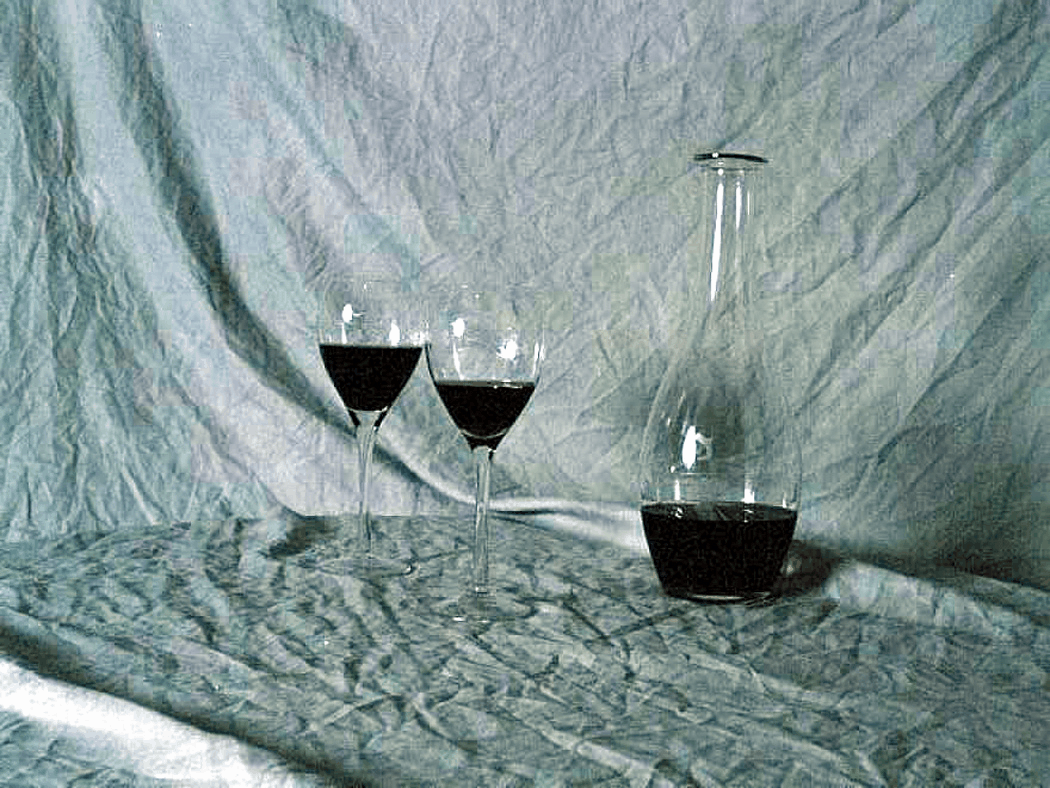
This shot is underexposed due to an aperture that is too small. (click for larger image)
Figure C shows the same shot, appropriately exposed by flash meter at f/8. That's quite a difference in range.
FIGURE C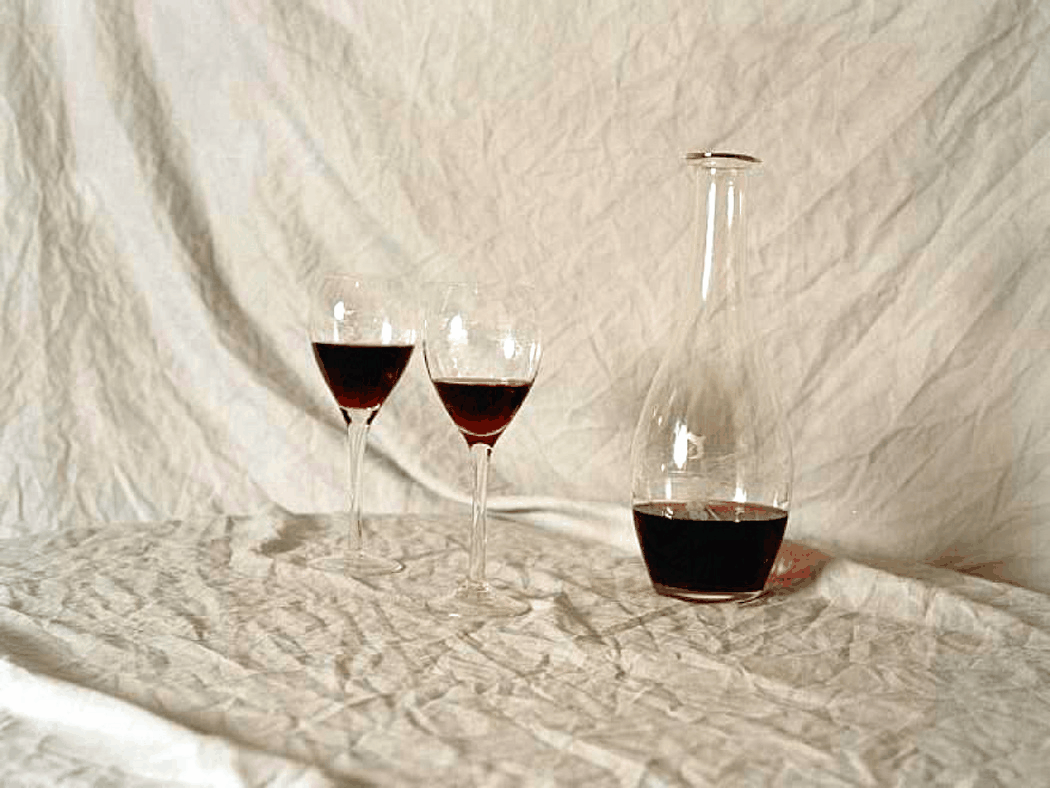
The same shot, appropriately exposed by flash meter. (click for larger image)
After testing some exposures under controlled conditions, I came to the conclusion that the published guide numbers for my SunPak units are either flat-out wrong, or both of the units have had identical intensity fall-off, which I think rather unlikely. I've determined that the actual guide number for full power with 400 speed film is 110, not 200.
I also learned something that had never occurred to me before, because I use a flash meter. When using a reflector umbrella, you will lose one full aperture stop due to the reflector's scattering of the light. Taking another look at our original example where we came up with an aperture setting of f/11, we would actually want to drop that to f/8 because of the use of a reflector umbrella, and then bracket the shot between f/8 and f/11.
Bear in mind, the underexposed example shot is not a fault of the guide number system, but rather the fault of an incorrect guide number. After determining what the true guide number was, and recomputing the math, taking into account the reflector umbrella, I came up with a result much closer to the flash meter. Not identical, but within one stop. When using the guide number system, you would bracket your shots anyway. Even if you choose not use a flash meter, you should at the very least verify the guide numbers for your flash units with a borrowed or rented meter.
That concludes this portion of our tour
The guide number system is a measurement of the light intensity of a flash or strobe at a given film speed. The higher the ASA/ISO of the film, the higher the GN will be. The higher the GN, the smaller the aperture needed for proper depth of field. By dividing the guide number by the distance the light travels to the subject, you can calculate the proper aperture for the best depth of field. Regardless of how many flash or strobe units you use, there's a mathematical formula to figure the appropriate aperture.
When using reflector umbrellas, you will also lose one full f/stop. We also learned that you can't always trust the published guide numbers and should verify them by meter prior to wasting film. If you're using more than one flash or strobe unit though, do yourself a favor and get a flash meter. In the long run, it will pay for itself in saved film and time. Good luck and good shooting.
[By the way, guide numbers are also somewhat applicable to digital photography. Many cameras shoot at film-speed equivalents. So, if you know that your camera is shooting digitally at the equivalent of 100 speed film, for example, you could then go on and use the guide numbers with some degree of confidence. --DG]
James Booth is a self-taught PC and Palm device user who dabbles in graphics and photography. He can be reached at lizardworks@mchsi.com.