
By David Gewirtz
Sometimes, the art of photography can be hard, complex, and very expensive. Sometimes, it's so simple, and so inexpensive, it almost seems too easy. Making a perfect backdrop for small product photos is one of those things that's both incredibly easy and amazingly inexpensive.
I recently had to do a quick product shoot for Computing Unplugged where I wanted to compare the size of two new Pocket PC handhelds, the Dell Axim X30 and the Navman PiN, as shown in Figure A.
FIGURE A
The two handhelds, side-by-side, makes for an easy comparison. (click for larger image)
As you can see, the result looks pretty much like it came from a standard, professional product shoot. Personally, I think I overexposed the nameplate in the middle of the PiN, but, as always, I was on deadline and the images look good enough and definitely got the story across.
I must have used some fancy studio gear, right? You might think I used a professional lighting setup, a gang of floodlights, and a specially manufactured backdrop, designed specifically for product photography. You'd be wrong.
I used a $0.69 piece of white cardboard and some tape, as shown in Figure B.
FIGURE B
I taped a piece of white cardboard to my desk and a box. (click for larger image)
It turns out, this approach makes for an excellent small product backdrop. In this case, we're looking at an 8.5" x 11" piece of card stock and some blue painter's tape. By taping the card stock down to the box and the desk, I got a nice gentle curving backdrop behind the products I was shooting.
To be fair, I cheated on the shot a bit. I didn't set up a full lighting rig. I just used available light, augmented by the flash on the camera. This isn't the best way to light a product shoot (we'll talk about that another week), but it was fast and got the job done.
By the way, do notice the blue tape, shown in Figure C.
FIGURE C
This is painter's tape and it doesn't leave residue behind. (click for larger image)
Painter's tape, like gaffer's tape, is extremely useful in that it doesn't leave a residue behind. 3M guarantees no residue as long as the tape is removed before three days. I bought my roll of painter's tape some time ago at the local Home Depot. It's about $4 for a roll that'll last you a very long time.
In fact, the tape peels off so well, and so cleanly, it even peeled right off the cardboard, neither leaving a residue, nor damaging the cardboard itself. So, not only can you use a $0.69 piece of cardboard for your backdrop, you can reuse it over and over.
I also used my handy backdrop to shoot the tape image, above. You might notice a blue cast on the background, which I probably should have gotten rid of using Photoshop. Again, for the purposes of getting the article done on deadline, I just ignored it. Normally, I'd take another few minutes and either tune the camera's white balance or tweak the image in Photoshop, as I did with the Pocket PC shot.
Once the backdrop's been assembled (OK, taped to the desk), you can set your products on it, as shown in Figure D.
FIGURE D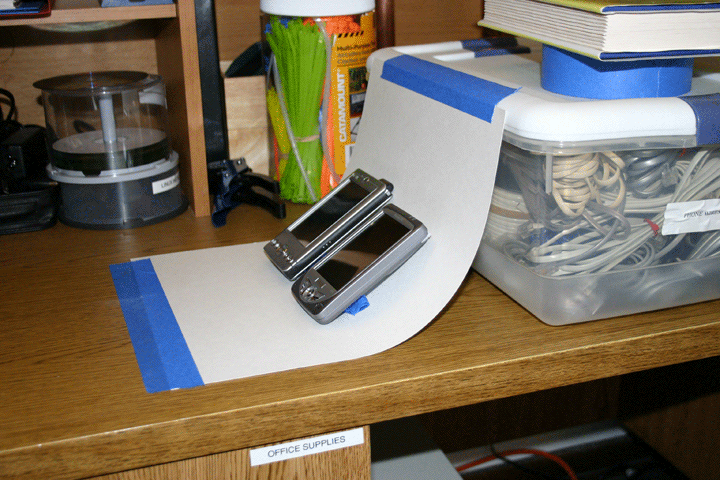
The two Pocket PCs are secured with a bit more tape. (click for larger image)
If you look carefully, you'll notice the Navman PiN has a blob of blue tape behind it. That's because, when I set the handhelds on the backdrop, they kept sliding down. A blob of blue tape behind each resolved the problem. It took some additional futzing to get both to line up together, and then I took my shot.
Once the shot was taken, I did the normal Photoshop magic. I cropped the image tight. Because it was intended for presentation on the Web (rather than art for my wall), I down-sampled it to 72dpi and resized the image to 480 pixels high, which works great for a Web-based image.
And, there ya go. A $0.69 piece of cardboard and you've got a backdrop. By the way, you can extend this idea a bit. You can buy larger cardboard sheets at your local art supply store for a buck or two, and you can also get different colors, so you're not limited to white. If you're taking a picture of a piece of silver jewelry, for instance, you might want to try placing it on a piece of black cardboard.
After all, when the backdrops are only $0.69, you can certainly afford to experiment.