
By James Booth
Winter photography presents a whole new basket of challenges when it comes to getting the correct exposure. The unique environmental variables presented by snow can challenge the most advanced photographers and equipment. With the recent glut of snow that's been dumped on the U.S. this past week, I felt a little information on how to deal with this cold, white, nuisance was in order.
Regardless of whether it's snow, some other light (or even dark) expanse, large-scale uniform color will confound the even the newest exposure sensors. The trick is to make your exposure for the contrast in the composition, and bracket your shots.
Your equipment
Before you go diving in and snapping pictures of the frost and ice clinging to the bare limbs of some ancient arboreal growth, or you try to shoot the latest incarnation of Frosty in the front yard, you need to know a thing or two about winter photography. First and foremost, you must be aware of the battery in your camera. Batteries hate cold, and will lose their charge dramatically faster and longer they're exposed to the cold.
"Batteries hate cold, and will lose their charge dramatically faster and longer they're exposed to the cold."
If you're on a location shoot, keep your camera, or its battery at the very least, inside your coat until you're ready to start shooting. Extra batteries, also kept inside that nice warm coat, are a mandatory for a winter location shoot.
The second thing to keep in mind is the effect of the environment on your camera. Your camera needs to adjust to the cold before it can be used. A warm camera suddenly exposed to frigid temperatures will fog up from the moisture of the air in and around it. Give the camera a few minutes, the few minutes it will take you to install that warm battery, to let it temperature adjust.
When you return from your shoot, the converse is true as well. A cold camera brought into a warm environment will fog again as warm moisture condenses on, and in, the unit. Let the camera come to room temperature for a couple of hours to ensure all the moisture has evaporated before storing in it.
The typical dry conditions of winter can also wreak havoc on film, if that's what you're shooting. Rapid advancement of the film can actually generate static electricity inside the camera, damaging the film and causing streaks as it's advanced.
And finally, that cold, dry environment can also affect the shutter, slowing down its response. This is one more justification for bracketing your shots.
The shutter speed you use will vary according to the type of shot you're taking. If you're shooting action, such as skiers, snowboarders, or skaters, you'll need a higher shutter speed, like 1/500 or more, in order to freeze the action. You'll have to adjust to a wider aperture accordingly. Landscapes and stills are much more accepting of slower shutter speeds, letting you use a smaller aperture.
You're only going to be successful when shooting in sunshine. To get the best results, shoot in the morning or afternoon, when long shadows create contrast, otherwise your images will be flat, lacking contrast and texture. Altering the angle of light on your subject to create more shadows and contrast is one tactic for getting a good exposure in a snowy environment. By creating more areas of contrast, or shadow, and exposing for those, your meter will give you a reading that's more equally balanced, and a better chance at a properly exposed shot.
The best results though will come from shooting against the sun when it's high in the sky. This'll give the snow its trademark sparkle. However, this presents problems with metering for proper exposure. The highly reflective snow, and all the light coming off of it, will fool your camera's exposure meter into a faster shutter speed and higher aperture than what is actually needed.
Most often, winter shots tend to be underexposed, resulting in a dark, flat image. Figure A is a prime example of the result you'll generally get if you let your camera decide how to expose the shot.
FIGURE A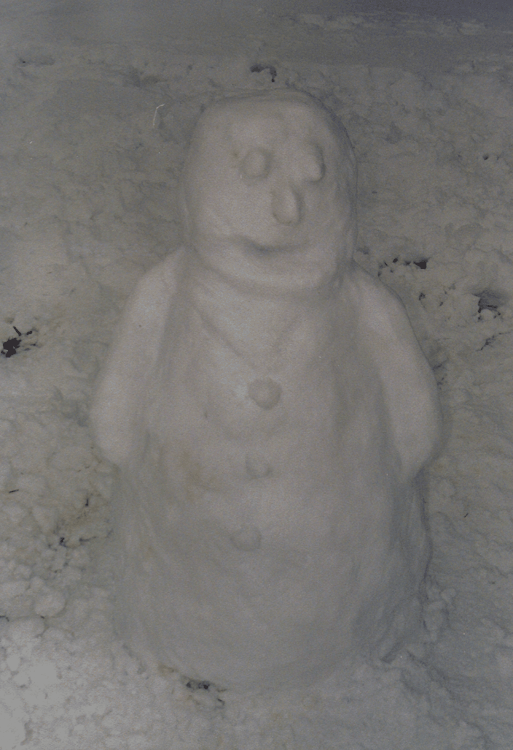
Settings of uniform color with low or no contrast will confound your exposure meter. (click for larger image)
Note how everything is drab, dark and under exposed. This is what happens when the exposure meter attempts to compensate for all the light it detects reflecting off the snow. The meter is confused, and underexposes the shot. The trick is to expose for something other than the snow itself. The shot in Figure B was exposed for the little girl; unfortunately, the color of her coat contrasted too much with the snow, and the snow was overexposed.
FIGURE B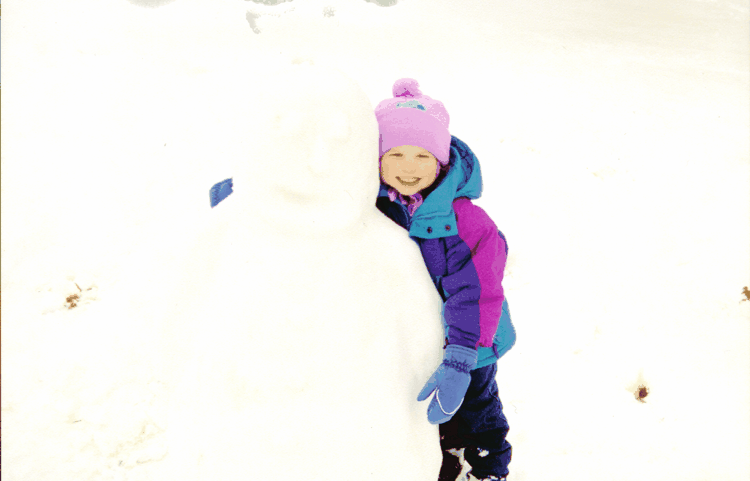
Compensating for the reflective qualities of snow can be tricky. (click for larger image)
Point and shoot cameras, and SLRs like my wife's Maxxum 300si that are fully automated (and which I hate), have an extremely difficult time compensating for extremes of exposure. These kinds of cameras are almost worthless when it comes to winter photography, as evidenced by the two images in this article. You need to have complete control over the camera's exposure.
The exposure problem that snow represents is compounded with digital cameras, as my limited exposure to them so far has shown me they tend to overexpose to begin with. In addition, a camera's autofocus can be confused by the low contrast that a snow expanse presents, and you may be forced to switch to manual focusing.
The best advice is to read the exposure for your shot using the exposure meter built into your camera, and adjust the aperture up by two stops. So if the meter reads proper exposure at f/11, adjust down to f5.6, this will be your baseline shot. Now bracket your shots, taking one at f/4, one at f/8, and one at the metered f/11. This should give you a broad range of exposures, providing you with at least one at the proper exposure. If your lens supports half-stops, adjust the aperture by 1 1/2 stops instead of a full two, and bracket at each half-stop.
I'd very much like to give you an example of a properly exposed winter shot, but because of the inherent difficulties, I tend to shy away from taking them. The film I use isn't exactly cheap, and there are the developing costs of a professional lab to take into account as well.
That said, while Connected Photographer's Editor-in-Chief David Gewirtz tells me he hates winter, for some reason, he's really into winter photography. He gave me two examples that showcase wintry scenes. The first, shown in Figure C, takes advantage of the inherent contrast of the mountain.
FIGURE C
Pay attention to the blackest blacks and the whitest whites. (click for larger image)
As David describes it, "Black and white imagery is so powerful, rendering this photo forbidding, yet beautiful. When converting an original color scan into black and white, a great deal of attention needs to be paid to the blackest blacks and the whitest whites, in order to bring out the highlights and shadows. I'm quite satisfied with the results in this image, although the black area on the right side of the image retained much more texture in the high resolution print that hangs on my wall."
Another approach is to provide a vivid contrast between the subject of the photo and the surrounding background, as David did in Figure D.
FIGURE D
Provide a vivid contrast between the subject and the surrounding image. (click for larger image)
David says, "Sometimes the contrast of the scene is nothing short of breathtaking. The juxtaposition of a vivid man-made object against a natural backdrop is just stunning."
If you'd like to try your hand at winter photography just remember, by default, your images are going to be underexposed, and you'll need to compensate for that. Good luck and good shooting.